 Loutra
What does a nicotine craving feel like?
By Loutra · Sources (8)
The short answer
It rarely starts in the body. It starts as a thought you did not decide to have, triggered by something around you — the coffee, the car, the end of a meal — or by withdrawal itself. Then your brain elaborates it: it builds the taste, the smell, the gesture. That sensory image is what gives a craving its physical texture, and it is also what makes it hurt: the image is pleasurable for a second and sharpens the sense of lack the next. The NHS puts it plainly — "a smoking craving is a strong urge to smoke" — and notes that cravings "usually only last a few minutes".
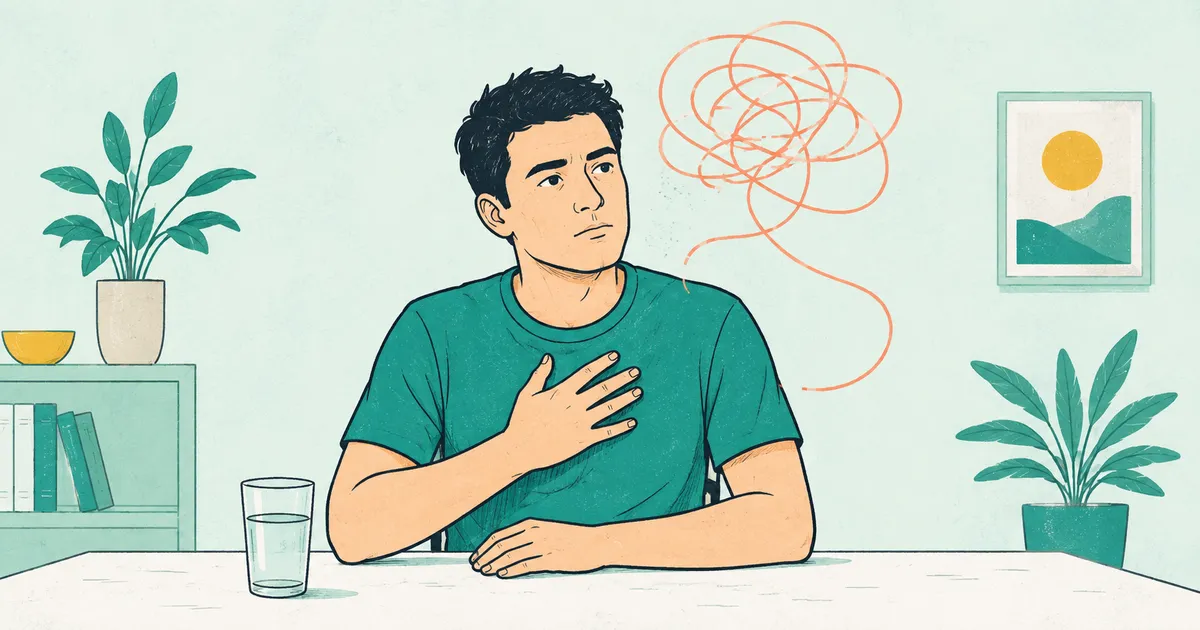
It does not start in the body
You are doing something else. Nothing hurts, you are not thinking about tobacco. And then it is there — not a pain, not a wave of dizziness: an idea. The idea of a cigarette, dropped into the middle of your day, uninvited.
This is the first thing almost nobody says about cravings: they arrive through thought, not through the lungs. The NHS is describing exactly that when it lists what sets them off — cravings "can be triggered by things like routines, such as having a coffee or waiting for the bus". A coffee sends no chemical signal to your brain. It sends a learned one.
The standard account of that mechanism appeared in Psychological Review in 2005, under a title that describes the experience better than any blog post could: Imaginary relish and exquisite torture. Kavanagh, Andrade and May start from a simple observation: intrusive thoughts about the thing you want "are triggered automatically by external or physiological cues and by cognitive associates".
Automatically. That is the word that matters, and it is the one that should take some weight off you. The first second of a craving is not yours. It is not a confession, it is not weak resolve, it is not the result of any decision you made. What is yours is the second second.
What makes it physical is an image
Because something else happens right after, and that is where a craving gains its bulk. When the intrusive thought "elicits significant pleasure or relief", the authors write, "cognitive elaboration usually ensues". You do not simply think cigarette: you develop it. You see yourself going outside. You feel the lighter. You anticipate the first drag.
And here is the detail that explains the rest: what the elaboration produces is sensory imagery, "especially important" precisely because those images "simulate the sensory and emotional qualities of target acquisition". The taste. The smell. The catch in the throat. Your brain is not sending you an administrative reminder — it is replaying the scene in high definition.
That is why a craving feels physical even when your blood nicotine level has nothing to do with it. And it is why it grows the more you attend to it: each return to the image buys a second of pleasure, and the authors end the sentence where it hurts — those images are "momentarily rewarding but amplify awareness of somatic and emotional deficits". You pour yourself an imaginary glass of water and come away thirstier.
A theory that can be tested, and was
A theory of desire that puts mental imagery at the centre makes a sharp prediction: occupy the visual part of your brain with something else and the craving should drop. Not vanish — drop.
That is what was put to the test, with Tetris. A 2014 laboratory study asked volunteers to report their spontaneous cravings and rate their strength, vividness and intrusiveness; half then played Tetris while the others waited in front of a program designed never to load. The two groups started out indistinguishable. Afterwards, the players had "significantly lower craving" and "less vivid craving imagery".
The second study, in 2015, left the laboratory — and that is the one that counts, because cravings do not happen in front of a research computer. Thirty-one participants were prompted seven times a day for a week to report what they wanted, and how badly, on a scale of 100.
Two caveats, because they are more useful than the number: the sample is small (31 people, students) and the effect size is modest — the authors give it themselves, f² = 0.11. This is not a switch. It is a real reduction, measured on cravings nobody induced, and replicated twice.
What the NHS actually says
The NHS has never cited any of these studies, and lands in the same place anyway. Its definition runs to two sentences: "a smoking craving is a strong urge to smoke. It happens because your body is used to nicotine, and without it, you feel like you need a cigarette."
And it refuses to choose between the body and the habit, which is the honest position: "cravings are not just caused by habits. Nicotine withdrawal can also trigger them." Withdrawal, it adds, leaves you "irritable" and "restless" — states that do not create the craving so much as make it "even more powerful".
Then comes the advice: "cravings usually only last a few minutes, so have a distraction ready. Play an online game, try a riddle, or do a simple workout." An online game. A riddle. Written by a public health service with no reference to any theory of desire, that is word for word what a visuospatial working-memory load is supposed to do.
The head, the hands, the mouth
The rest of the NHS tip list describes the shape of a craving better than any definition does — by the three places you feel it.
- The head — "play an online game, try a riddle". The part of the craving that keeps returning as a thought.
- The hands — "keep your hands busy with a fidget spinner". The reflex of taking something to your mouth, which survives the cigarette.
- The mouth — "chew on things like carrots, celery sticks, or sugar-free gum", which the NHS says helps "satisfy the urge to have something in your mouth".
Three channels, three counters. If you have ever felt a craving was "in your hands", you were not imagining it, and the health service treats it that way.
Why it feels like it will keep climbing
That leaves the hardest sensation to describe, and the most decisive: from inside a craving, you have no information about what happens next. It is rising, so it will keep rising. That is what your brain concludes, and it is wrong.
The clinical counter to it is forty years old and goes by a slightly silly name: urge surfing. The principle, as an overview of Marlatt's model describes it: "the client is taught to visualize the urge or craving as a wave, watching it rise and fall as an observer and not to be 'wiped out' by it". The real lesson is not the metaphor but what it demonstrates — "rather than building interminably until they become overwhelming, urges and cravings peak and subside rather quickly if they are not acted on".
One of the model's authors checked in 2009 whether it works, on 123 smokers exposed to smoking cues, half of them given brief instructions to observe the urge rather than fight it. The result is more interesting than a clean success would have been: both groups reported urges of the same intensity. But over the following seven days, the trained group smoked significantly fewer cigarettes. The authors put it without any triumph: these techniques "may not initially reduce urges to smoke but may change the response to urges".
That is the most useful sentence in all of this. The point was never to make the craving small. The point is that it stops being an instruction.
What it does not mean
A craving is not proof that your body needs a cigarette right now: it can start from a coffee, with no chemical signal behind it at all. It is not a sign you are doing this badly either — the NHS lists urges among the normal symptoms of withdrawal and adds that they "do not last" and are "a sign your body is starting to heal". And it is not a prophecy: the image your brain replays is a recomposed memory, not a forecast of how the cigarette would actually feel.
What it does mean is concrete. A craving has a shape: it opens as a thought, swells into an image, and subsides if nobody feeds it. Each of those three stages has a handle, and the most available one is also the least dignified: give your eyes something else to do for three minutes.
An app replaces neither a stop smoking adviser nor a treatment — NHS stop smoking services are free, and they are what to use if your cravings look like an under-dosed patch. Loutra counts the days, keeps the history even when a day goes badly, and gives you something to look at for those three minutes.
Questions people ask
What does a nicotine craving feel like?
Like a thought that arrives on its own and then settles in. The NHS defines it as "a strong urge to smoke". In practice most people describe three things at once: something in the head (the idea of the cigarette, which you cannot quite stop returning to), something in the hands (the reflex of bringing something to your mouth), and something in the mouth (the taste, the wanting to inhale). The NHS tip list is organised the same way — a game for the mind, a fidget spinner for the hands, carrots or sugar-free gum for the mouth.
Is a craving physical or psychological?
The question is badly framed, and the NHS answers both ways: cravings "are not just caused by habits", nicotine withdrawal "can also trigger them". So a craving can start from a signal in your body or a signal in your environment — but in both cases what you then experience runs through a very concrete mental image. That is why it feels physical while still yielding to things that are not physical at all, like a game or a riddle.
Why can I taste the cigarette when I am not smoking?
Because that is roughly what is happening. The standard theory of desire, published in Psychological Review in 2005, puts sensory imagery at the centre of craving: those images matter because they "simulate the sensory and emotional qualities of target acquisition". Your brain is not sending you an administrative reminder, it is replaying the scene. And the authors finish the sentence where it hurts: desire images are "momentarily rewarding but amplify awareness of somatic and emotional deficits".
Does playing a game on your phone actually help with cravings?
It is the one technique here that has been measured outside a lab. Thirty-one participants were prompted seven times a day for a week; those who played Tetris for three minutes after reporting a craving saw its strength drop by a mean of 13.9 points out of 100, across all craving types (nicotine, alcohol, caffeine, food, activities). The effect is real, the sample is small, and the effect size is modest. The NHS, citing no study at all, advises you to "play an online game" or "try a riddle".
Why does a craving feel like it will keep growing forever?
Because from inside one, you have no information about what comes next. The clinical technique known as urge surfing exists precisely to supply it: the person learns to watch the urge like a wave, and in doing so learns that "rather than building interminably until they become overwhelming, urges and cravings peak and subside rather quickly if they are not acted on". The sense of endless escalation is a prediction you are making from inside the wave, not an observation.
Does resisting a craving make it stronger?
That is not what was measured. In a trial where 123 smokers were exposed to smoking cues, the group taught to observe urges without fighting them did not report weaker urges than the control group — but they smoked significantly fewer cigarettes over the next seven days. The authors concluded that such techniques "may not initially reduce urges to smoke but may change the response to urges". Which is to say: the goal was never to make the craving small.
Is it normal to crave a cigarette when I am past withdrawal?
Yes, and the NHS says so in both directions: cravings come from habits and from withdrawal. A craving set off by your morning coffee or by waiting for the bus does not need your body to be asking for anything — an associated cue is enough. It is also why how long a craving lasts tells you nothing about how long withdrawal lasts: they are two different clocks.
Loutra is free on the App Store
An otter that’s counting on you, a daily check-in, and a breathing round for the minutes that are hard.

Sources
- NHS — Understand your smoking triggers and cravings (Better Health) — nhs.uk
- NHS — Managing nicotine withdrawal symptoms (Better Health) — nhs.uk
- Kavanagh DJ, Andrade J, May J — Imaginary relish and exquisite torture: the elaborated intrusion theory of desire. Psychological Review 2005;112(2):446–467 — pubmed.ncbi.nlm.nih.gov
- Skorka-Brown J, Andrade J, May J — Playing Tetris reduces the strength, frequency and vividness of naturally occurring cravings. Appetite 2014;76:161–165 — pubmed.ncbi.nlm.nih.gov
- Skorka-Brown J, Andrade J, Whalley B, May J — Playing Tetris decreases drug and other cravings in real world settings. Addictive Behaviors 2015;51:165–170 — pubmed.ncbi.nlm.nih.gov
- Larimer ME, Palmer RS, Marlatt GA — Relapse prevention: an overview of Marlatt's cognitive-behavioral model. Alcohol Research & Health 1999;23(2):151–160 — pmc.ncbi.nlm.nih.gov
- Bowen S, Marlatt A — Surfing the urge: brief mindfulness-based intervention for college student smokers. Psychology of Addictive Behaviors 2009;23(4):666–671 — pubmed.ncbi.nlm.nih.gov
- NHS — Find your local stop smoking service — nhs.uk