 Loutra
Why do I get anxiety after drinking?
By Loutra · Sources (15)
The short answer
Because the calm alcohol gives you in the evening is paid back in the morning. The US National Institute on Alcohol Abuse and Alcoholism calls it a "mini-withdrawal": the brain adjusts to the soothing effect, and "when the buzz wears off, people can feel more restless and anxious than before they drank." Add a fragmented second half of the night and, sometimes, a memory gap. In a study of 97 people during real evenings with friends, the shyest drinkers' anxiety rose clearly the next morning, after a barely measurable dip the night before. The NHS sums it up: "hangovers often make you feel anxious and low." The thing to watch is not one anxious Sunday; it is drinking to calm it. And if you need a drink when you wake up, do not stop suddenly without medical advice: for someone who is dependent, stopping abruptly can be dangerous.
It is not a character flaw. It is a rebound
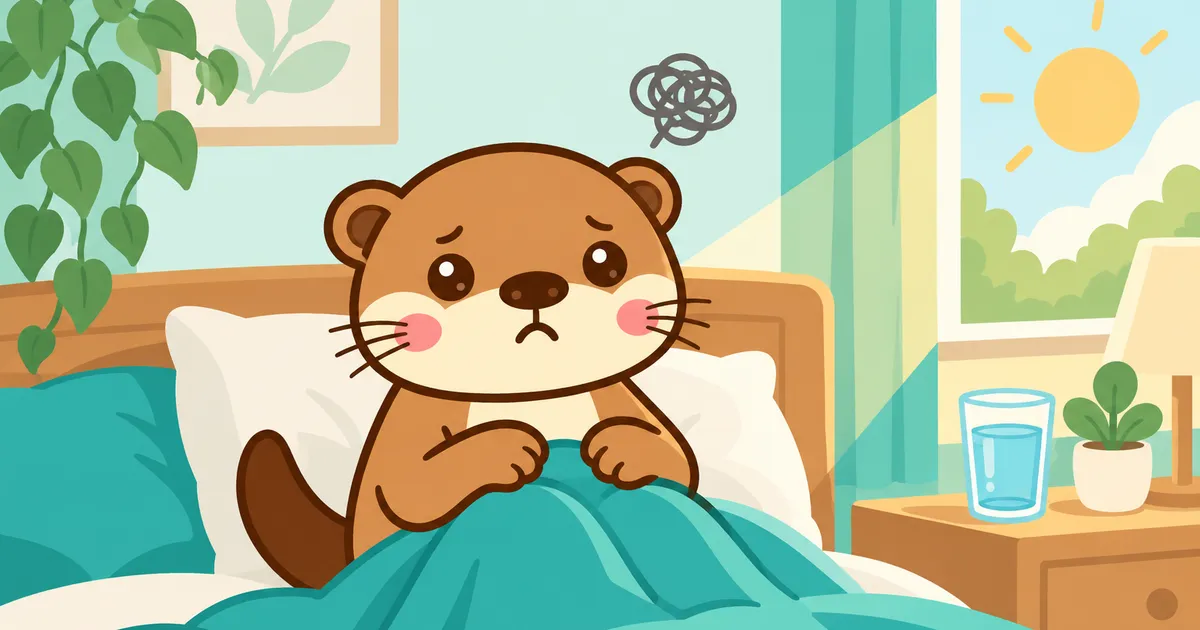
You wake before the alarm, heart a little too fast, and your mind has already started replaying the evening line by line. Nothing terrible happened, probably. The feeling does not care. It has a popular name, hangxiety, and an explanation that health bodies write down in plain words.
The Royal College of Psychiatrists starts with the chemistry: alcohol increases the effect of GABA, the neurotransmitter that "calms" the brain and body, "so at low levels alcohol can make you feel calmer, or less anxious." The US National Institute on Alcohol Abuse and Alcoholism (NIAAA) describes what follows and calls it a mini-withdrawal: while drinking you may feel calmer and more relaxed, "but the brain quickly adjusts to those positive effects as it tries to maintain balance. As a result, when the buzz wears off, people can feel more restless and anxious than before they drank."
The exact mechanism is still debated — the NIAAA lists several factors that "can contribute" to a hangover rather than a single cause — but the direction is not.
Then the night, then the gap
Two things pile on top of the rebound. The first is sleep. People may fall asleep faster after drinking, says the NIAAA, "but their sleep is fragmented, and they tend to wake up earlier." The review by Ian Colrain, Christian Nicholas and Fiona Baker places the damage precisely: alcohol is sedating at first, but "this effect disappears after a few hours, resulting in a fragmented and disturbed sleep in the second half of the night."
The second is memory. Drinking a lot, fast, temporarily stops the brain from recording memories, writes France's national alcohol helpline, so the next day you cannot remember what you did — "an experience that can be very distressing." The researchers behind the shyness study below name rumination, going over the evening again and again, as something future work should look at. A lead, not a finding.
- During the eveningAlcohol soothes. In the Marsh study, barely: a "marginal" drop in anxiety.
- Second half of the nightThe sedation has worn off: fragmented sleep, waking earlier.
- On wakingSymptoms peak as blood alcohol returns to about zero (NIAAA).
- Up to a day or more"24 hours or longer", says the NIAAA, and worse the more you drank.
What the research actually measured
Adele McKinney and Kieran Coyle, at the University of Ulster, tested 48 students on two mornings: once after an evening of their usual drinking, once after an evening without alcohol. After the drinking night, alertness and tranquillity ratings were lower, and the authors concluded that heavy drinking "lowers mood, disrupts sleep, increases anxiety".
The study by Beth Marsh, Celia Morgan and colleagues, published in 2019, puts the word in its title. It took place in people's homes, during a real evening with friends: 50 drank as they normally would, 47 stayed sober, and anxiety was measured before, during and the next morning. Among the shyest participants, alcohol lowered anxiety only "marginally" in the evening, and it was clearly higher the next day. Among the less shy, nothing significant, at comparable intake. And among the very shy, the bigger the next-day rise, the higher their score on the AUDIT screening questionnaire — which led the authors to call hangover anxiety a "potential marker for increased AUD risk", meaning alcohol use disorder.
The limits are real: nobody was blinded, only about twenty very shy participants drank, people with severe social anxiety were excluded, and a correlation is not a cause. But the detail that matters is there: the evening's relief is barely measurable, the morning's anxiety clearly is. Joshua Smith and Carrie Randall's review points the same way: laboratory studies of alcohol's anxiety-reducing effect "have produced mixed findings", and what people expect alcohol to do "can motivate drinking independent of alcohol's actual physiological effects".
What the NHS says, exactly
Its page on cutting down, reviewed on 9 April 2026, gives mood a paragraph of its own: "There's a strong link between heavy drinking and depression, and hangovers often make you feel anxious and low. If you already feel anxious or sad, drinking can make this worse, so cutting down may put you in a better mood generally."
Its page on anxiety, reviewed on 13 July 2026, says it from the other side: "try not to use alcohol, cigarettes, gambling or drugs to relieve anxiety as these can all contribute to poor mental health." The Royal College of Psychiatrists makes the loop explicit: "If you have a pre-existing mental health problem, you might drink alcohol to try and feel better. However, this can have the opposite effect."
When it becomes a warning sign: drinking to calm what the drinking caused
One anxious Sunday does not mean you are dependent: the NIAAA lists anxiety among the typical symptoms of a hangover. What changes the reading is what you do with it. In the large US NESARC survey, Kyle Menary and colleagues looked at drinkers with an anxiety disorder. About one in five said they drank to control their anxiety — and that is where dependence was concentrated.
By the next wave of the survey, in 2004-2005, the self-medicators also had higher odds of having developed a new dependence (odds ratio 3.77), partly because they were drinking more. This is an observational survey of self-reports in people with a diagnosed anxiety disorder: it does not measure hangxiety. It shows where the risk sits.
The clearest case is the morning drink, which the NIAAA says "might temporarily minimize some symptoms" but "could contribute to and prolong the malaise". And the NHS lists "anxiety after waking" among the withdrawal symptoms that may need medicine. The difference comes down to one question: does the anxiety follow a night of drinking, or does it arrive on the mornings you have not had a drink? If it is the second, the NHS is blunt: "It can be very dangerous to stop drinking suddenly if you're dependent on alcohol. If you get withdrawal symptoms, get medical help before you try to stop drinking." The detail is in the article on stopping suddenly.
What helps, and what does not
For the hangover itself, no remedy has been "scientifically proven to be effective", says the NIAAA: "There is no cure for a hangover other than time." For the anxiety that comes back every weekend, the lever is the drinking. The Royal College of Psychiatrists says that "after a few weeks of not drinking you might start to feel better physically and mentally", and the NHS lists "feeling better in the mornings" among the immediate effects of cutting down — set out in the article on a month without alcohol.
Loutra counts the days and asks for one check-in a day; a relapse does not wipe the history. It does not replace a GP or a therapist, and if the anxiety stays once the alcohol has gone, that is where it belongs. In the UK, Drinkline is on 0300 123 1110. If your thoughts turn dark, call or text 988 in the US or Canada, or call the Samaritans on 116 123, day or night.
Questions people ask
Is "hangxiety" a medical term?
No. It is a popular blend of hangover and anxiety, and the researchers who studied it present it that way: "a phenomenon known in popular culture as 'hangxiety'". The symptom itself is recognised. The NIAAA lists anxiety among the typical symptoms of a hangover, and so does France's national alcohol helpline. The word is new; the experience is not.
How long does hangover anxiety last?
The NIAAA says hangover symptoms peak when your blood alcohol concentration returns to about zero, and "can last 24 hours or longer"; the more you drank, the worse it tends to be. Anxiety that turns up on mornings when you have not been drinking, or that only a drink settles, is a different thing: the NHS lists "anxiety after waking" among the withdrawal symptoms of physical dependence.
Does a drink in the morning help?
Briefly, a little. After that, no. The NIAAA files "hair of the dog" under myths: it "might temporarily minimize some symptoms", but "could contribute to and prolong the malaise". And the NHS lists "needing a drink when you wake up in the morning" among the signs of alcohol-use disorder. If that is where you are, do not stop abruptly on your own: talk to a doctor first, for the reasons set out in the article on stopping suddenly.
Why do I get it and my friends don't?
One measured answer is shyness. In the study by Marsh and colleagues, only the shyest participants had a significant rise in anxiety the next morning, though they had not drunk more than the others. And the opposite is not necessarily good news: the Royal College of Psychiatrists writes that not getting hangovers "can be a sign that your body has got used to you drinking a lot".
If I stop drinking, will the anxiety go away?
Often it eases, not always straight away. The Royal College of Psychiatrists says that "after a few weeks of not drinking you might start to feel better physically and mentally." In a study cited by Smith and Randall's review, of 23 patients in a residential programme who had an anxiety disorder and stayed abstinent for about 120 days, 61% no longer met the criteria for it. But in heavy drinkers some withdrawal symptoms can last a few months, says the NHS, and anxiety that stays can have its own cause: that is one to take to a GP.
Where can I get help?
In the UK, your GP or a local alcohol service, or Drinkline on 0300 123 1110, the free national alcohol helpline listed by the NHS. If your thoughts turn dark — the Royal College of Psychiatrists notes that drinking can increase the risk of self-harm and suicide — call or text 988 in the US or Canada, or call the Samaritans free on 116 123 in the UK and Ireland, day or night.
Loutra is free on the App Store and Google Play
An otter that’s counting on you, a daily check-in, and a breathing round for the minutes that are hard.

Sources
- NHS — Tips on cutting down on alcohol (mood, sleep; page reviewed 9 April 2026) — nhs.uk
- NHS — Get help with anxiety, fear or panic (not using alcohol to relieve anxiety; page reviewed 13 July 2026) — nhs.uk
- NHS — Alcohol-use disorder (signs, withdrawal symptoms, the warning on stopping suddenly; page reviewed 24 April 2026) — nhs.uk
- NHS — Alcohol support (anxiety after waking among symptoms that may need medicine; Drinkline; page reviewed 17 August 2026) — nhs.uk
- NIAAA (National Institutes of Health) — Hangovers (the "mini-withdrawal", fragmented sleep, hair of the dog; updated December 2025) — niaaa.nih.gov
- Royal College of Psychiatrists — Alcohol, mental health and the brain (published February 2024) — rcpsych.ac.uk
- Marsh B, Carlyle M, Carter E et al. — Shyness, alcohol use disorders and "hangxiety": a naturalistic study of social drinkers. Personality and Individual Differences 2019;139:13-18 — doi.org
- McKinney A, Coyle K — Alcohol hangover effects on measures of affect the morning after a normal night's drinking. Alcohol and Alcoholism 2006;41(1):54-60 — pubmed.ncbi.nlm.nih.gov
- Smith JP, Randall CL — Anxiety and alcohol use disorders: comorbidity and treatment considerations. Alcohol Research: Current Reviews 2012;34(4):414-431 — pmc.ncbi.nlm.nih.gov
- Menary KR, Kushner MG, Maurer E, Thuras P — The prevalence and clinical implications of self-medication among individuals with anxiety disorders. Journal of Anxiety Disorders 2011;25(3):335-339 — pmc.ncbi.nlm.nih.gov
- Colrain IM, Nicholas CL, Baker FC — Alcohol and the Sleeping Brain. Handbook of Clinical Neurology 2014;125:415-31 — pmc.ncbi.nlm.nih.gov
- Alcool info service (Santé publique France) — Alcool et fête : quels sont les risques ? (hangover symptoms, blackouts) — alcool-info-service.fr
- 988 Suicide & Crisis Lifeline (United States) — 988lifeline.org
- 9-8-8: Suicide Crisis Helpline (Public Health Agency of Canada) — 988.ca
- Samaritans — Contact a Samaritan (116 123, free, day or night) — samaritans.org